
Auto insurance premiums across the United States have reached historic highs, creating significant pressure on household budgets and forcing millions of American motorists to re-evaluate their monthly expenses. Rising costs across the automotive sector—including expensive replacement components, advanced sensor technology, elevated labor rates at collision repair facilities, and larger medical settlements—have compelled insurance underwriters to adjust their baseline rates upward. In response to these spikes, many vehicle owners are tempted to slash their policies down to the bare legal minimums required by their home states. However, pursuing cheap coverage by stripping away critical protections frequently creates severe financial vulnerability. A single at-fault accident can easily generate damages exceeding statutory minimums, such as the standard 25/50/25 liability limit ($25,000 for bodily injury per person, $50,000 total bodily injury per incident, and $25,000 for property damage). When claims surpass those caps, the at-fault driver remains personally liable, exposing personal savings, home equity, and future wages to legal judgments.
True affordability in auto insurance is not about acquiring the lowest possible quote on paper; it is about maximizing value, eliminating redundant surcharges, and optimizing coverage parameters to fit your actual risk profile. Every insurance carrier in the U.S. evaluates risk differently, balancing variables such as geographic territory, vehicle safety ratings, credit-based insurance scores, annual mileage, and driving history according to proprietary actuarial algorithms. Because insurance regulations vary state by state—from no-fault systems in Michigan and Florida to traditional tort systems in Texas and Ohio—drivers have distinct rights and strategic options available to them. By learning how underwriters assess risk, making calculated policy adjustments, taking full advantage of technological tools like telematics, and actively comparing quotes across distinct provider categories, you can dramatically lower your annual expenditure while preserving a robust financial safety net.
Strategic Coverage Adjustments: Optimizing Deductibles and Eliminating Redundancies
The most immediate path toward lowering auto insurance premiums without sacrificing foundational liability protection involves fine-tuning your physical damage coverages and shedding unnecessary policy endorsements. Comprehensive and collision coverages protect your own vehicle against damage from accidents, vandalism, weather events, or theft. These coverages carry deductibles—the out-of-pocket sum you agree to pay before your insurer covers the remaining loss. Many drivers carry standard $250 or $500 deductibles set years ago. By raising your collision and comprehensive deductibles to $1,000 or $1,500, you can reduce the physical damage portion of your premium by anywhere from 15% to 30%. As long as you maintain an accessible emergency fund capable of covering the higher deductible in the event of an incident, this adjustment offers substantial ongoing savings with minimal practical downside.
Another essential step is auditing your policy for redundant or outdated coverages. A dependable guideline followed by financial advisors is the “10% rule.” If the combined annual cost of collision and comprehensive coverage exceeds 10% of your vehicle’s actual cash value (ACV)—which can be determined through valuation sources like Kelley Blue Book or Edmunds—it is often mathematically wise to drop those optional coverages entirely. For an older vehicle worth $3,500, paying $500 to $700 annually for collision and comprehensive makes little financial sense, particularly after factoring in the deductible and standard vehicle depreciation.
Additionally, examine supplementary riders that duplicate benefits you already hold through other services. Roadside assistance programs provided by insurance policies can often be canceled if you already maintain coverage through AAA, credit card perks, or your vehicle manufacturer’s warranty. Similarly, rental car reimbursement can be safely eliminated if your household maintains a secondary, reliable vehicle that you can use while repairs take place. Crucially, never reduce your bodily injury and property damage liability limits to generate savings. In the insurance marketplace, doubling or quadrupling your liability limits from 25/50/25 to 100/300/100 typically costs only a few extra dollars per month because catastrophic claims are statistically rare, giving you exponentially higher protection for a negligible price difference.
Maximizing High-Impact Discounts and Telematics Programs
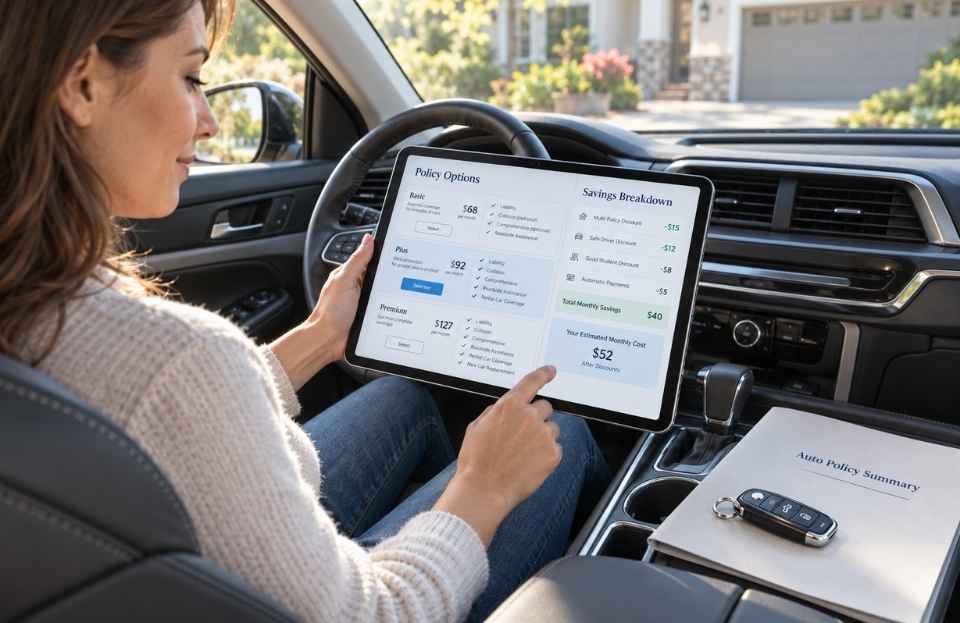
Insurers offer an extensive catalog of discounts, but they are rarely applied automatically; policyholders must identify them and request their addition. The single most impactful standard discount is multi-policy bundling. Combining your auto insurance with your homeowners, renters, or condominium insurance under the same carrier routinely yields savings between 10% and 25% across both policies. For urban renters paying modest monthly insurance premiums, pairing that coverage with an auto policy can generate auto discounts that effectively offset the entire cost of the renters’ policy. Further administrative discounts—such as enrolling in paperless statements, setting up automatic electronic fund transfers (EFT), or paying the full six-month or annual premium upfront—can immediately shave another 5% to 10% off the total bill by eliminating installment transaction fees.
For motorists willing to share real-time driving data, usage-based insurance (UBI) and telematics programs represent one of the fastest-growing avenues for major premium reductions. Major national carriers offer smartphone applications or plug-in On-Board Diagnostic (OBD-II) devices that track key driving metrics over a trial period of 90 to 180 days. These systems evaluate parameters including hard braking events, rapid acceleration, late-night driving hours, total mileage, and smartphone handling while behind the wheel. Cautious drivers who avoid aggressive maneuvers and minimize driving between midnight and 4:00 AM can qualify for ongoing premium discounts ranging from 15% to 40%.
For individuals who work remotely, carpool, or drive fewer than 7,500 miles annually, specialized pay-per-mile auto insurance models offer tailored alternatives to conventional static pricing. Under pay-per-mile structures, policyholders pay a modest daily base rate paired with a few cents per mile driven, ensuring that low-mileage drivers do not subsidize the elevated crash risk of daily highway commuters. Supplementing these strategies with driver safety credits—such as completing an approved state defensive driving course or maintaining a “B” grade average for student drivers—further secures downward pressure on premiums across all household vehicles.
Navigating the Competitive Market: Comparison Shopping and Broker Insights
Because auto insurance underwriting models are entirely proprietary, rate quotes for an identical driver, vehicle, and coverage profile can vary by more than $1,000 annually between competing companies. Insurers calculate premiums based on loss ratios within specific ZIP codes, their current market appetite for certain vehicle types, and historical claim volumes. A company experiencing high loss ratios in a particular region will elevate rates across that entire territory, whereas a competing carrier seeking to expand market share in the same jurisdiction may offer aggressive promotional discounts. Consequently, comparing quotes every 12 months—especially at renewal or following significant life transitions—is vital to maintaining the lowest possible rate.
To shop effectively, consumers must understand the three distinct distribution channels operating within the U.S. insurance market: direct carriers, captive agents, and independent insurance brokers. Direct carriers allow consumers to bind policies entirely online or over the telephone without intermediaries. Captive agents represent a single proprietary brand and possess specialized expertise regarding that company’s discount structures. Independent insurance agents and brokers, by contrast, maintain contractual relationships with dozens of regional and national mutual carriers that do not advertise heavily on broadcast television. Working with an independent broker allows you to compare multiple vetted quotes simultaneously, often uncovering competitive regional insurers that offer lower expense ratios and superior customer satisfaction scores compared to massive nationwide conglomerates.
When gathering quotes, ensure you compare identical coverage limits, endorsements, and deductible tiers across all proposals to establish an accurate baseline. Additionally, in the majority of U.S. states, insurers evaluate your credit-based insurance score when determining policy pricing. Actuarial data demonstrates a strong statistical correlation between credit stability and claim frequency. Maintaining a solid credit profile by keeping credit utilization below 30% and paying bills promptly can reduce insurance costs by hundreds of dollars per year. In states where credit-based insurance scoring is prohibited by law—such as California, Hawaii, Massachusetts, and Michigan—insurers place heavier emphasis on annual mileage and verified driving records, making clean driving history the primary lever for securing optimal pricing.
Long-Term Cost Control: Preserving Low Premiums and Financial Stability
Securing a competitive auto insurance rate is an ongoing practice of proactive policy maintenance rather than a one-time transaction. Sustaining bottom-tier premiums over several years requires consistent defense of your motor vehicle record (MVR). Moving violations, such as speeding citations, failure to yield, or improper lane changes, typically remain on your state driving record for three to five years, triggering surcharges that can erase prior discounts. More serious offenses, including reckless driving or driving under the influence (DUI), result in immediate non-renewals, policy cancellations, or compulsory high-risk assignments requiring costly SR-22 filings. Practicing defensive driving and addressing minor traffic citations promptly through defensive driving deferrals helps protect your preferred insurance tier.
Equally critical is exercising discretion regarding when to file a claim. While insurance exists to protect against financial catastrophe, filing frequent claims for minor repairs is one of the most common causes of rate inflation. If your vehicle suffers minor cosmetic damage costing $1,200 to repair and your collision deductible is $1,000, filing a formal claim yields a net payout of only $200 while alerting underwriters to an incident. The resulting loss of a “claims-free” discount,t combined with potential at-fault surcharges over the subsequent three-year rating cycle,e will often cost far more than the nominal insurance payout. Saving insurance claims strictly for major, catastrophic events safeguards your claims history and keeps your baseline premium intact.
Finally, conduct a comprehensive annual review of your policy to account for life updates that affect risk categorization. Moving to a safer neighborhood, relocating closer to your workplace, changing jobs to work from home, parking in a secured garage, or paying off an auto loan (which allows you to eliminate lender-mandated gap insurance) should trigger an immediate notification to your carrier. As your personal net worth expands over time, consider pairing your cost-optimized auto and home policies with a standalone personal umbrella policy. A $1 million umbrella policy typically costs between $150 and $300 annually, providing a substantial layer of supplementary liability protection while allowing you to comfortably fine-tune your underlying auto policy parameters without fearing personal financial exposure.
Frequently Asked Questions About Affordable U.S. Car Insurance
What is the fastest way to lower car insurance rates immediately?
The quickest method to decrease your premium without changing insurance carriers is to raise your comprehensive and collision deductibles (for instance, moving from $500 to $1,000) and immediately apply any unlisted discounts. Bundling your auto coverage with a renters or homeowners policy, enrolling in automatic monthly payments (EFT), setting up paperless billing, and verifying that your listed annual commute mileage accurately reflects your current driving habits can produce instant rate adjustments on your existing policy.
Is it safe to carry only the state-mandated minimum liability coverage?
Carrying only state-minimum liability coverage is legally permissible but financially risky for most American drivers. Most state minimums were established decades ago and have not kept pace with inflation or modern medical and repair costs. If you cause an accident involving multiple vehicles or serious physical injuries, a $25,000 or $50,000 limit can be exhausted immediately. Any remaining medical expenses or property claims will be pursued directly against your personal assets, savings accounts, and future wages through court-ordered judgments.
How much money can a telematics or usage-based program actually save?
Drivers who enroll in telematics programs generally receive an immediate enrollment discount of 5% to 10%, followed by performance-based discounts ranging from 15% to 40% at policy renewal. The exact savings depend upon your driving habits, specifically whether you avoid hard braking, rapid acceleration, nighttime driving between midnight and 4:00 AM, and phone interaction while operating the vehicle. Cautious, low-mileage drivers benefit the most from these programs.
At what point should I drop collision and comprehensive coverage?
You should consider dropping comprehensive and collision coverage when the annual cost of those two coverages exceeds 10% of your vehicle’s actual cash value (ACV), or when the vehicle’s market value drops below $3,000 to $4,000. If your car is worth $3,000 and your deductible is $1,000, the maximum possible payout you could receive after a total loss is only $2,000, making significant annual premium payments economically inefficient.
Does getting multiple car insurance quotes hurt my credit score?
No. When car insurance carriers assess your credit profile to calculate your credit-based insurance score, they perform a “soft pull” or soft inquiry. Soft inquiries do not affect your FICO score or VantageScore in any way, regardless of how many different insurance companies you consult during your comparison shopping process.